
7 Ways Conversational Forms Improve Affiliate Signup Rates
-
- Tips and Tricks
- 8 mins read
Your affiliate program success depends more on the affiliate quality and network strength than the offer itself. And most affiliate programs often fail not because of poor offers, but because of low affiliate signup rates. This is why you need to enhance your affiliate signup form in order to improve affiliate signup rates.
A potential affiliate clicks your signup page, feels interested, and then sees a long form demanding too many details at once. The Interest drops immediately as they feel exhausted writing too many information in one place. That’s how affiliate signup rates sink without anyone noticing. Conversational forms reduce that pressure by turning the process into smaller steps.
If you’re wondering how this mechanism works, you’ve come to the right place. The article discusses how you can structure your affiliate sign-up forms in conversation style and share a few quick tips to make it interesting. So without wasting more time, let’s dive deeper.
Why Affiliate Signup Forms Underperform
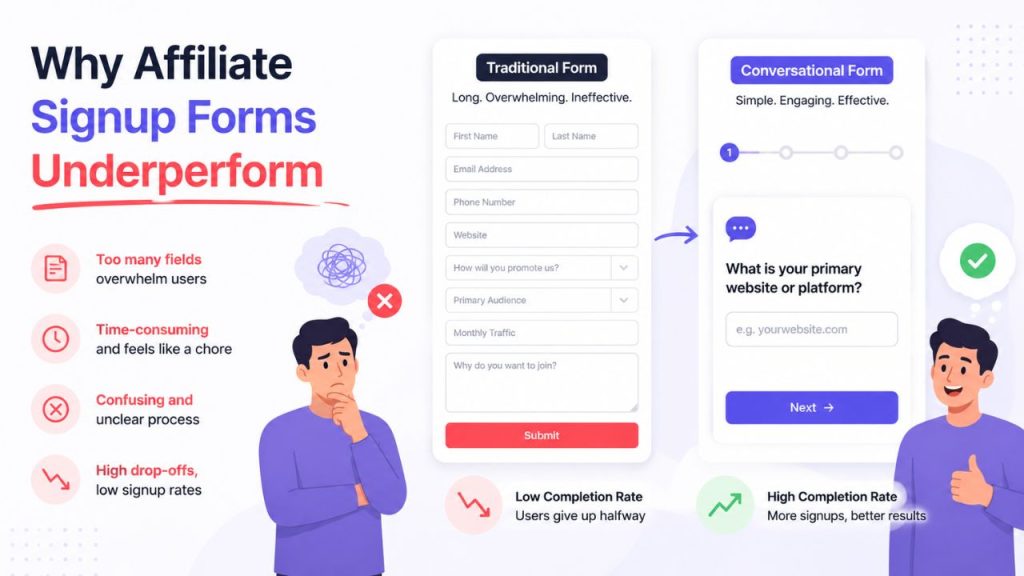
Most affiliate forms ask for everything at once. Contact details, traffic sources, social profiles, payout information, promotion methods. Especially from a mobile user, this quickly feels exhausting. When the form looks lengthy from the beginning, people delay the submission and often abandon it halfway. This drop-off impacts your affiliate program success. Because you might be missing out on some of the best affiliates in your niche.
The problem is most businesses don’t consider this as a problem. From their perception, they assume that the offer might be poor. So they keep increasing commissions and offering it to the same small group of affiliates they have. What they could do instead is open the door of the program to a bigger affiliate group simply by optimizing their signup form.
The key to solve this problem is not removing essential fields; you need those information. The solution is to build your form in a way so that affiliates feel less burdened and can provide information step by step. Instead of facing a long page, potential affiliates answer one focused question at a time, which keeps the flow moving and makes completion feel easier although it doesn’t remove most questions.
How Conversational Forms Improve Affiliate Signup Rates
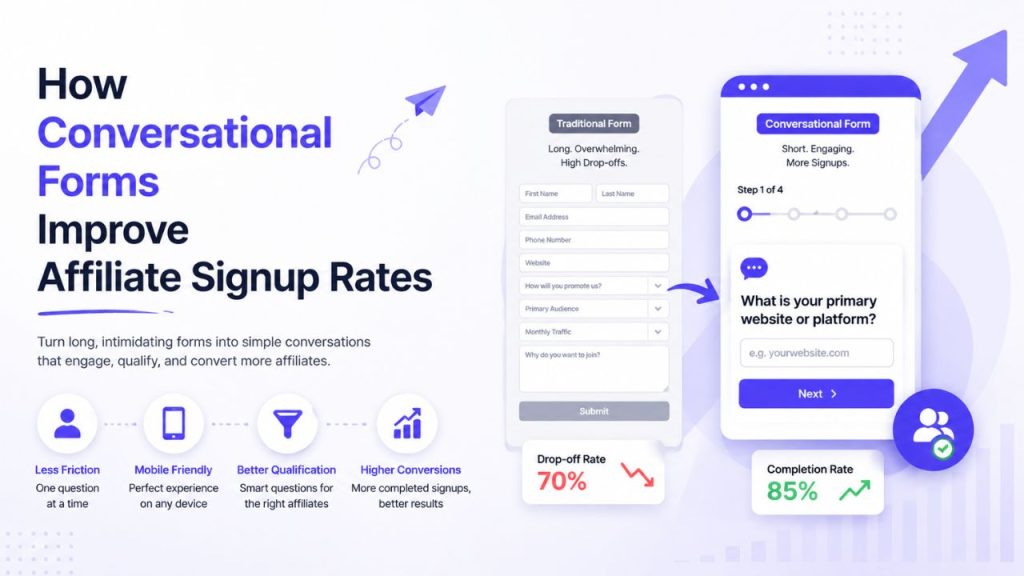
Conversational forms change this by turning a static data collection sheet into a guided, step-by-step flow. For affiliate programs, this matters more than it might sound. When the signup experience is smooth, more people complete it. And when more people complete it, your affiliate signup rates improve.
A small structural change provide meaningful effects on completion behavior. The process feels shorter, easier to continue, and less mentally demanding, especially on mobile devices where long static forms create even more friction. You get to attract more top quality affiliates who’ll guarantee you a better return of the effort and succeed your campaigns.
With FormGent, affiliate signup forms can be built as guided conversation flows directly inside WordPress-native builder. Contact details, audience information, and promotion methods can be accepted separated into various screens, making the overall experience feel more manageable without removing any important qualification questions. Adding media in each step makes the visual more engaging and interactive.
How to Build a High-converting Affiliate Signup form
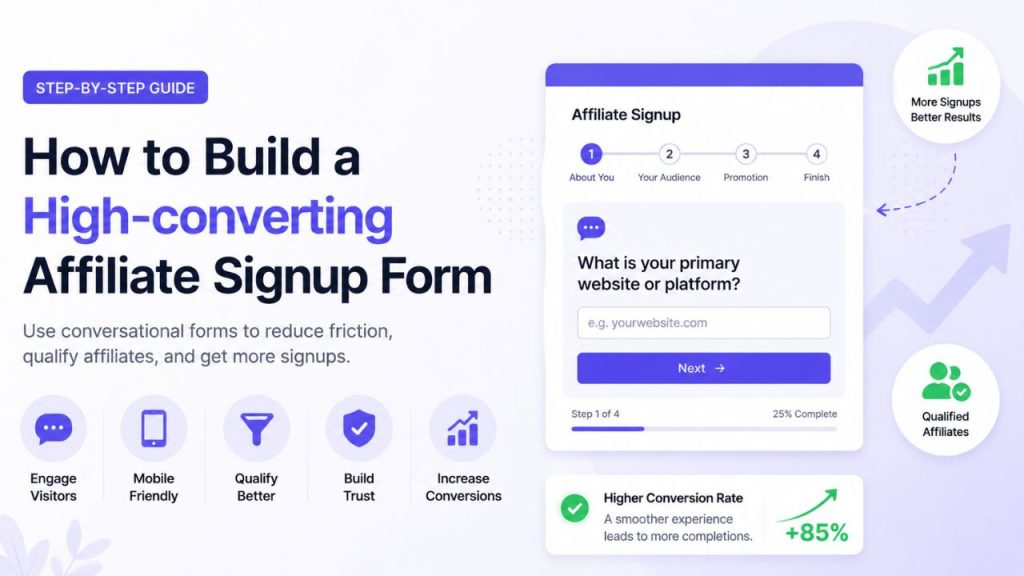
Here’s how you can make your affiliate signup form work in conversation style flows and increase affiliate signup rate.
1. Reduce Friction with a one question at a time Flow
Conversational forms display one question at a time – be that name, email, traffic source, promotional methods etc. So when affiliates are asked questions one in one step, the psychology automatically changes. There’s no visual overload, no sense of how much work is ahead. Each step feels small and manageable, so users keep moving forward.
They don’t feel like they’re filling a form. They feel like they’re having a conversation. It reduces friction, guarantees more completions, resulting in higher affiliate signup rates. And the best part is you’re not missing out information because despite changing the form structure, you’re not removing any essential fields. It’s a shift of behavior without change of requiremenets.
2. Make the Mobile Experience Work
Most affiliates work with their phones – signing up, creating content, promoting offers and even withdrawing payments. They tap a link, open a signup page, and immediately face a form that’s hard to navigate on a small screen. Even if they’re interested, the effort feels too high – and they leave.
Conversational forms are inherently mobile-friendly because they show one question at a time. No horizontal scrolling, no pinching to zoom, no trying to tap a field that’s too small. The user moves through a clean, focused flow from start to finish. When mobile signups stop dropping off, your overall affiliate signup rates improve automatically.
3. Pre-Qualify Affiliates Without Turning Anyone Away
Not every signup is a good fit. Onboarding low-quality affiliates wastes time on your end and produces poor results over the long run. However, asking some heavy qualification questions upfront is a fast way to lose people before they’ve even started.
Conversational forms can help you pre-qualify naturally. Because questions come one at a time, users answer them as part of a flowing process rather than reading a list of requirements. You can ask about their niche, traffic source, or promotion method without it feeling like an interrogation. Then you can take it further using the conditional logic option.
You can show or hide follow-up questions based on what an affiliate answers in previous questions. Someone who selects “social media” as their channel sees different follow-up questions than someone who selects “email newsletter.” The form adapts to each applicant, which makes the experience feel relevant rather than generic.
The result is better-qualified applicants and fewer wasted onboarding hours – without driving away genuine candidates.
4. Keep them Engaged Until Completion
Most affiliate signup forms rely too heavily on text. Applicants are expected to read long explanations, understand multiple steps, and decide whether the process is worth finishing before they even begin. Conversation forms with visual structure reduces that effort immediately.
Instead of explaining every stage with paragraphs, a well-designed affiliate signup form can guide users using media, images and clean layouts that communicate meaning at a glance. Users understand the flow faster because the interface itself explains what is happening.
For example, promotion channels can be presented with media of media icons instead of requiring users to read through long dropdown lists. Step numbers make the process feel more organized and less administrative. This improves more than usability. It changes perception.
A visually structured onboarding flow signals that the affiliate program is actively managed, understands its audience, and values a better onboarding experience. That first impression matters because affiliates often judge the quality of a program long before approval happens.
5. Let Affiliates Save Their Progress and Come Back
Even a well-designed conversational form can’t account for life getting in the way. An applicant gets pulled into some other task, loses their connection, or simply needs more time to think through their answers. Without a way to save progress, that person is gone – and your program never hears from them again.
FormGent’s Save & Resume feature solves this in two ways. Auto-save captures whatever the applicant has entered so far, even if they close the tab without doing anything. The Resume Later option lets applicants intentionally save their progress and receive a personal link to continue when they’re ready.
That link does quiet work. When the applicant finds it in their inbox later, it’s a natural prompt to finish what they started – without you having to chase them. On your end, partial entries appear in the Entries Dashboard, so you can see exactly where drop-offs happen and how many applicants are mid-way through the form at any given time.
6. Protect Your Program with Verified Signups
A high affiliate signup rate doesn’t mean much if a significant portion of those signups are fake, low-intent, or using throwaway contact details. Your forms’s OTP verification feature can close that gap at the point of submission.
FormGent’s OTP verification feature sends a code to the applicant’s email or phone number – whichever they choose and the form won’t submit until they enter it correctly. Fake contact details simply can’t pass verification.
For affiliate programs where a real, reachable email or phone is the whole point of the signup, this layer of verification is worth adding. It keeps your affiliate list clean from the start. Combined with conditional logic to filter by niche and channel, you can build a signup form that collects exactly the information you need and rejects the applications that would waste your time.
7. Assure Every Applicant the Moment They Submit
The moment after submission is when an applicant is most attentive. What they see next shapes their first impression of how your program operates – and most programs waste it with a generic “Thanks for submitting.”
At minimum, your confirmation should tell the applicant their submission was received and that they’ll hear back. That alone reduces follow-up emails from people wondering if their form went through.
But if you’ve built pre-qualification into your form using conditional logic, FormGent’s Conditional Confirmation takes this further. You can show a different message to each applicant based on what they answered.
Applicants who meet your criteria see a message that sets expectations: “We’ve received your application and will be in touch shortly.” Applicants who don’t qualify see something honest and respectful: “Unfortunately your application doesn’t meet our current requirements. Thank you for your time – we wish you the best.”
That second message does real work. It closes the loop for the applicant without needing a follow-up email, removes them from your review queue, and handles the rejection gracefully – all from within the form itself, no email marketing tool required.
Managing Affiliates After They Sign Up: Where AffiliatePress Comes In
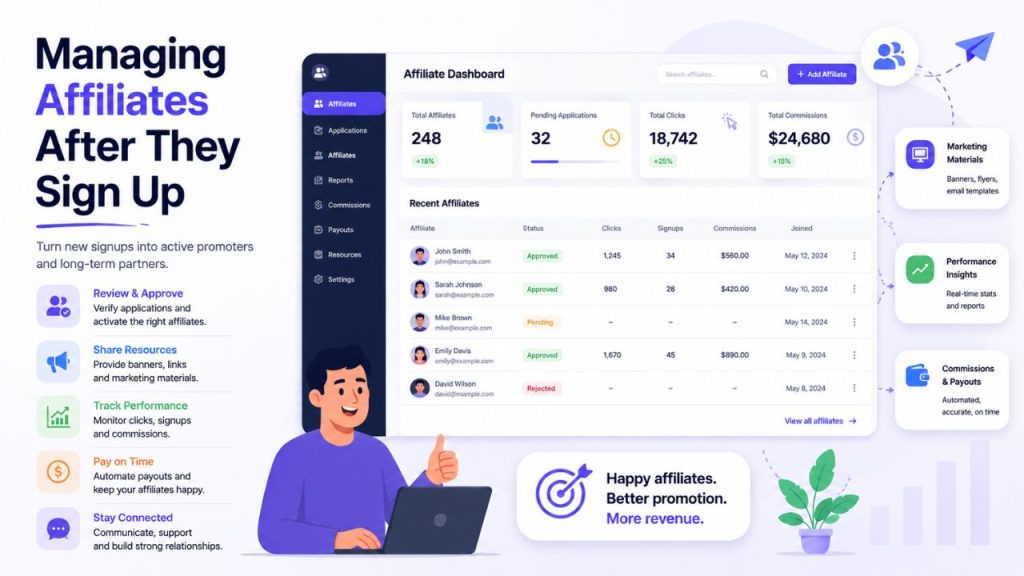
FormGent handles the signup experience – the form UX, mobile flow, conditional logic, progress tracking, verification, and data capture. What it doesn’t do is manage the affiliate program itself after someone joins.
That’s where AffiliatePress takes over.
Once an affiliate has completed the FormGent signup form, AffiliatePress handles everything that comes next: commission structures, affiliate tracking, automated payouts, WooCommerce integration, and fraud detection. It connects with 25+ WordPress plugins out of the box, so your affiliate infrastructure works with the rest of your site without custom development.
The combination works because the tools have different jobs. FormGent optimizes the entry point – the form experience that determines whether a potential affiliate converts. AffiliatePress manages the operational layer that makes the program run after that conversion happens.
If your affiliate signup rate is low, fix the form first. If your affiliate program is underperforming despite good signups, the issue is likely in program management, tracking, or payouts – and that’s where AffiliatePress gives you the controls you need.
Final Thoughts
Improving affiliate signup rates comes down to removing the barriers that stop interested people from completing the process. Conversational forms – built with the right structure, logic, and verification – do exactly that.
FormGent gives you the tools to build that experience natively in WordPress: multi-step flows, conditional logic, Save & Resume, progress indicators, and OTP verification. AffiliatePress gives you the backend to manage and grow the program once affiliates are in.
Start with the form. Everything downstream depends on it.

S. M. Navid Anjum
Digital Marketing enthusiast who loves to write technical reviews and trendy contents. Currently working with WordPress Plugin Marketing and growth. Open to collaboration and co-marketing opportunities with any SaaS and plugins.

Leave a Reply