
10+ Customer Satisfaction Survey Questions That Get More Responses
-
- Tips and Tricks
- 7 mins read
Looking for the right customer satisfaction survey questions to understand your customers better and encourage more responses? This guide shares practical, proven questions you can use to build a customer satisfaction survey, improve customer experience, and make data-driven decisions.
Customer satisfaction plays a direct role in retention, reviews, referrals, and revenue. Businesses that actively collect feedback outperform those that rely on assumptions or silence.
Many companies wait for reviews, support tickets, or social media complaints. When nothing shows up, they assume customers are happy. In reality, silence often means missed insight.
That’s why structured surveys matter.
In this guide, you’ll find practical customer satisfaction survey questions you can use across:
- client satisfaction surveys
- customer service satisfaction surveys
- user satisfaction surveys
These questions are designed to work for products, services, and WordPress websites alike.
Let’s dive in.
Why Customer Satisfaction Surveys Matter
A well-designed customer satisfaction survey helps you:
- Identify experience gaps early
- Improve customer service quality
- Reduce churn
- Strengthen trust and loyalty
Whether you’re running a SaaS product, service business, or online platform, asking the right questions to ask for surveys is what turns feedback into action.
Here are some important states that proves how important Customer Satisfaction Surveys is:
According to Zendesk Benchmark data, 3 in 4 consumers will spend more with a company that delivers a good customer experience—a direct reason why measuring customer satisfaction and improving it matters for revenue growth.
71% said customer satisfaction metrics were “very useful” for managing and monitoring their business performance—underlining how key satisfaction measurement is to strategic decisions. – Studocu
Research analyzing over 20,000 customer surveys found that a totally satisfied customer contributes 2.6 times more revenue than a somewhat satisfied one, and 17 times more than a somewhat dissatisfied customer—showing financial impact tied to satisfaction levels. – Rovaha
Customer Satisfaction Survey Question Examples
1. How satisfied are you with our product or service?
2. What words would you use to describe our product or service?
3. How likely are you to recommend us to others?
4. How would you rate our customer service?
5. What do you like most about our product or service?
6. What do you dislike about our product or service?
7. How easy is it to use our product or service?
8. Which features or services do you use most?
9. What could we do to improve your experience?
10. How well does our product or service meet your needs?
11. How responsive have we been to your questions or concerns?
12. Do you have any additional comments or suggestions?
13. How would you rate the value for money of our product or service?
14. What would you like us to add or improve next?
1. How satisfied are you with our product or service?
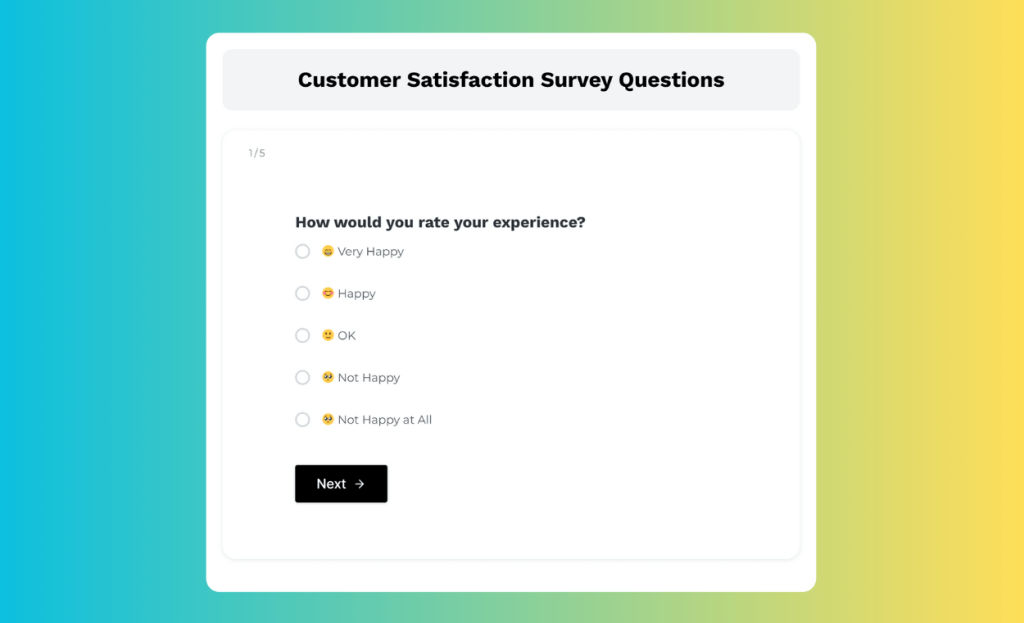
This is the foundation of any customer satisfaction survey.
Using a scale gives you a clear satisfaction benchmark. High scores show strong performance. Lower scores highlight issues before they escalate.
This question is essential in:
- user satisfaction surveys
- client satisfaction surveys
2. What words would you use to describe our product or service?
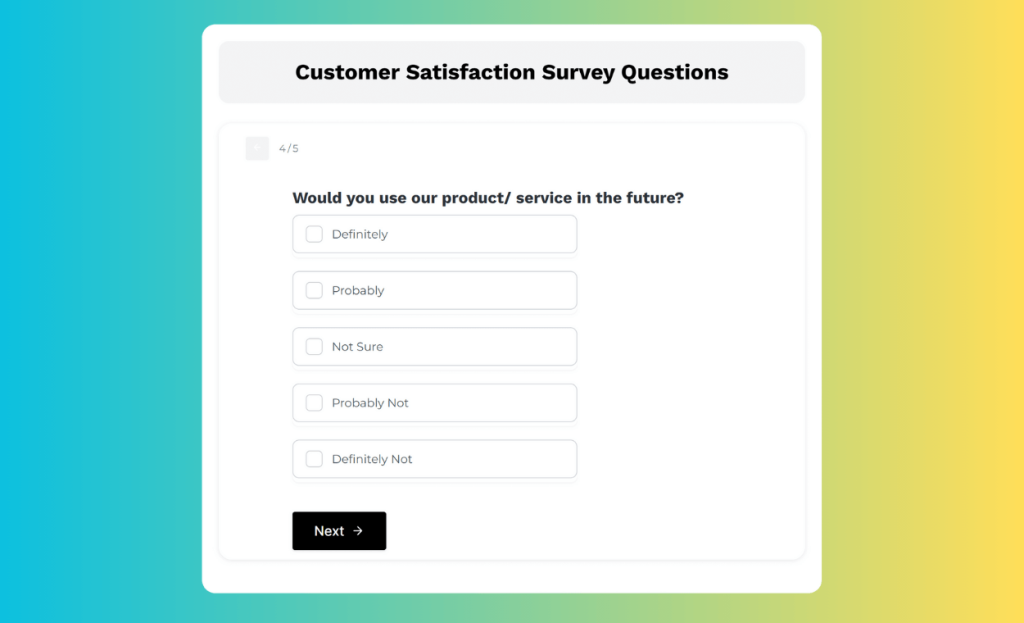
This question helps you understand customer sentiment in their own language.
Positive responses reveal strengths you should reinforce. Negative responses highlight friction points in the customer journey.
It works well in:
- customer care survey questions
- customer experience research
3. How likely are you to recommend us to others?
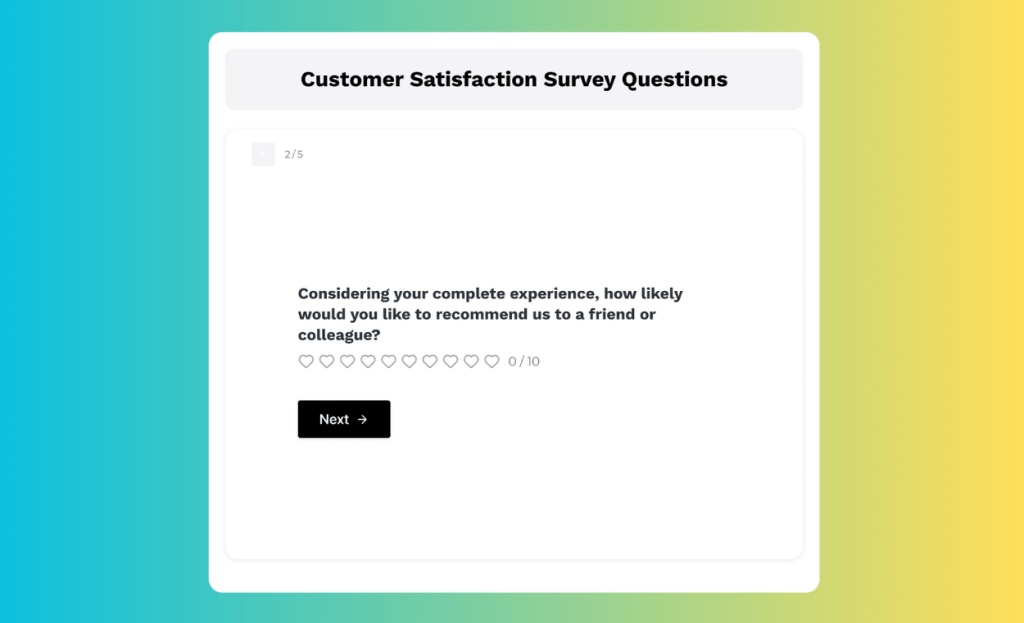
This is a classic customer satisfaction survey question used to measure loyalty through Net Promoter Score (NPS).
Scores help segment users into promoters, passives, and detractors—making it easier to prioritize improvements.
Commonly used in:
- customer service satisfaction surveys
- user satisfaction surveys
4. How would you rate our customer service?
Customer support heavily influences overall satisfaction.
This customer service questionnaire question helps you assess how well your team handles issues, communication, and response time.
Pairing this with an optional comment field gives deeper insight.
5. What do you like most about our product or service?
This question focuses on positive reinforcement.
Understanding what customers value most helps you:
- Improve retention
- Strengthen messaging
- Focus on high-impact features
It’s a staple in most sample customer satisfaction survey questions lists.
6. What do you dislike about our product or service?
This question balances the previous one and uncovers friction.
Direct feedback helps you fix issues before customers leave. Many businesses lose customers not because of major flaws, but because small frustrations go unresolved.
Ideal for:
- client satisfaction surveys
- customer care survey questions
7. How easy is it to use our product or service?
Ease of use strongly impacts satisfaction.
This question helps identify usability issues, onboarding gaps, or confusing workflows—especially useful for digital products and websites.
Often used in:
- user satisfaction surveys
- customer experience audits
8. Which features or services do you use most?
This question reveals what customers truly value.
High-usage features deserve more attention. Low-usage ones may need better visibility or improvement.
A strong addition to any customer satisfaction survey focused on product optimization.
9. What could we do to improve your experience?
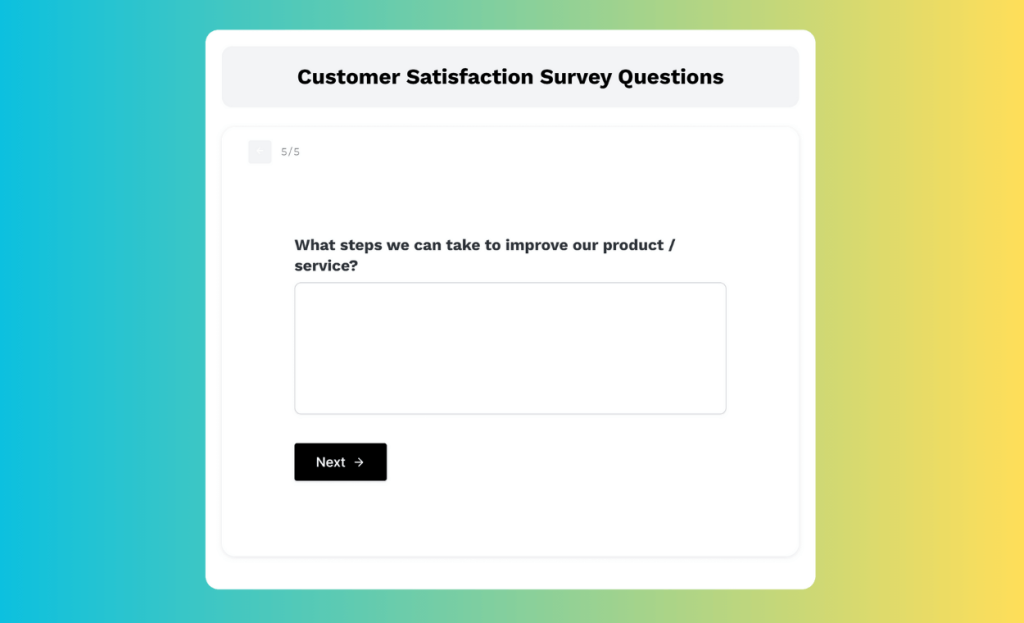
This is one of the most actionable questions to ask for surveys.
Customers often share clear, practical suggestions when asked directly. It also shows that you value their opinion, which builds trust.
10. How well does our product or service meet your needs?
This question measures expectation alignment.
Lower scores don’t always mean poor quality—they often indicate a mismatch between user needs and current offerings.
Frequently used in:
- customer satisfaction survey questions
- client satisfaction surveys
11. How responsive have we been to your questions or concerns?
Responsiveness directly affects trust and satisfaction.
This customer service satisfaction survey question helps you evaluate response speed and communication quality.
Even small improvements here can significantly boost customer perception.
12. Do you have any additional comments or suggestions?
This open-ended question ensures nothing is missed.
While open responses take more effort to analyze, they often provide insights that structured questions don’t capture.
Limit open-ended questions to avoid survey fatigue.
13. How would you rate the value for money of our product or service?
Perceived value influences long-term retention.
If customers feel the value doesn’t match the price, satisfaction drops—even if the product performs well.
This question is common in:
- customer satisfaction surveys
- client satisfaction surveys
14. What would you like us to add or improve next?
This question makes customers feel involved.
It provides direction for future updates and reinforces that customer feedback drives decisions—one of the strongest trust signals you can send.
Customer Satisfaction Survey Form Template
How to Calculate Survey Results
Once responses start coming in, the next step is understanding what the data actually tells you.
Most customer satisfaction survey questions ask respondents to rate their experience on a linear scale from 1 to 10. If a question doesn’t apply to a respondent, they can select N/A (Not Applicable). This keeps your data accurate and prevents forced or misleading answers.
To make sense of survey responses, businesses usually rely on a few standard metrics. Below are the most common ways to analyze customer satisfaction survey results.
Mean (Average)
The mean shows the average score for a question. It gives you a quick snapshot of overall sentiment and is useful for tracking changes over time.
Median
The median represents the middle value when all responses are sorted from the lowest to the highest. It helps reduce the impact of extreme scores and gives a more balanced view of customer opinion.
Mode
The mode is the most frequently selected score. This tells you how most customers answered, which can be helpful when responses cluster around a specific number.
Range
The range indicates the gap between the highest and lowest scores. A wide range may indicate mixed experiences, while a narrow range suggests consistency.
Score per Latent Variable
Latent variables group related questions together, such as:
- Brand image
- Customer expectations
- Service quality
Scoring by latent variable helps you understand which areas influence satisfaction the most.
Net Promoter Score (NPS)
NPS evaluates customer loyalty by questioning how probable it is that users will recommend your business. It categorizes responses into promoters, passives, and detractors, giving you a clear loyalty benchmark.
Standard Deviation
Standard deviation shows how spread out the responses are. A low deviation means most customers feel similarly. A high deviation suggests inconsistent experiences.
Variance
Variance also measures response spread, but in more detail. It’s often used alongside standard deviation to understand how stable or unstable customer satisfaction levels are.
Using these metrics together gives you a clear, structured way to turn raw survey data into insights you can act on.
Turning Survey Responses Into Action
Collecting responses is only the first step. Real improvement comes from acting on feedback consistently.
For WordPress users, building a customer satisfaction survey, customer service questionnaire, or user satisfaction survey doesn’t need to be complex. AI-powered tools like FormGent help you create flexible surveys faster, structure responses, and turn insights into action—without manual effort.
Listening to customers early builds trust. Acting on feedback keeps them loyal.
FormGent is a modern, AI-powered WordPress form builder designed to help businesses create smarter forms and collect meaningful feedback—without complexity.
With FormGent, you can quickly generate, customize, and launch forms using AI, making it easy to gather insights from customers, users, and teams directly on your WordPress site.
FormGent supports a wide range of use cases, including:
- Customer Satisfaction Surveys (CSAT)
- Net Promoter Score (NPS) surveys
- User feedback and experience surveys
- Customer service and support forms
- Lead capture and contact forms
These forms help you measure customer satisfaction, loyalty, and overall experience while keeping the process simple for both you and your respondents.
Whether you want to understand how users feel about your product, improve customer service, or collect feedback to guide better decisions, FormGent gives you the flexibility and speed to do it all—powered by AI and built for WordPress.
So don’t wait more! Try these high responsive customer satisfaction survey questions with FormGent!

Rezaul Karim
Rezaul Karim is a passionate Digital Marketer driven by curiosity and creativity in the ever-evolving world of online marketing. With over 6 years of hands-on experience in Content Writing, Copywriting, SEO, and Social Media Marketing, he brings a strategic edge to crafting content that engages and converts. Always eager to explore new trends and tools, Rezaul thrives on finding smarter ways to connect brands with their audiences. Outside of work, he enjoys diving into books or recharging in nature.


Leave a Reply