
Customer Complaint Form: The Ultimate Guide to Handling Complaints the Right Way in 2026 (with template)
-
- AI-Form Builder Tips and Tricks
- 23 mins read
Every unresolved complaint carries a quiet cost. Customers don’t always shout when something goes wrong—most of time they drift away without notify anything but leave subtle scars on your reputation, or air their grievances where you can’t respond. In 2026, silence is no longer neutral. It is a possible warning sign for your business. Businesses that rely on scattered emails, missed calls, or social media comments to capture dissatisfaction are gambling with trust they’ve already earned.
The problem deepens when complaints arrive without structure. Details are lost. Emotions escalate. Teams scramble. What should have been a moment of easy recovery becomes a reputational liability. Worse still, many organizations unintentionally push customers toward public criticism simply because there is no clear, private channel to be heard. This is how manageable issues metastasize into churn, negative reviews, and long-term erosion of loyalty.
You might have faces most the scenario or don’t want to face these. Whether you face or anticipate, you need a solution — that’s why you’re here. And here we’re are giving you today a better way to solve this. A thoughtfully designed customer complaint form transforms customers frustration into clarity. It gives customers a composed space to explain what went wrong, while giving your team the precision needed to respond decisively. A modern online customer complaint form doesn’t just collect problems—it orchestrates resolution, accountability, and trust. With the right customer complaint form template, complaints become signals, not threats.
This ultimate guide will show you how to handle complaints the right way in 2026—calmly, systematically, and surely with a Customer Complaint Form—so every issue becomes an opportunity to strengthen the relationship rather than fracture it.
In a hurry or looking for just the process of “How to Create Customer Complaint Form” or “Customer Complaint Form Template“? Just use the table of content to find your desire section.
TL;DR;
- What Is a Customer Complaint Form?
- Feedback Forms vs Customer Satisfaction Surveys vs. Complaint Forms
- Why Customer Complaint Forms Matter More Than You Think
- When Should You Use a Customer Complaint Form?
- What Makes a Good Customer Complaint Form?
- Essential Fields Every Customer Complaint Form Must Have
- Customer Complaint Form Question Examples
- Customer Complaint Form Template
- Common Mistakes Businesses Make With Complaint Forms
- 5 Best Practices Of Customer Complaint Form That Works Great
- How to Create a Customer Complaint Form (Step-by-Step)
- How to Handle Complaints After Submission
- Metrics to Track From Customer Complaint Forms
- Turning Complaints Into Trust
What Is a Customer Complaint Form?
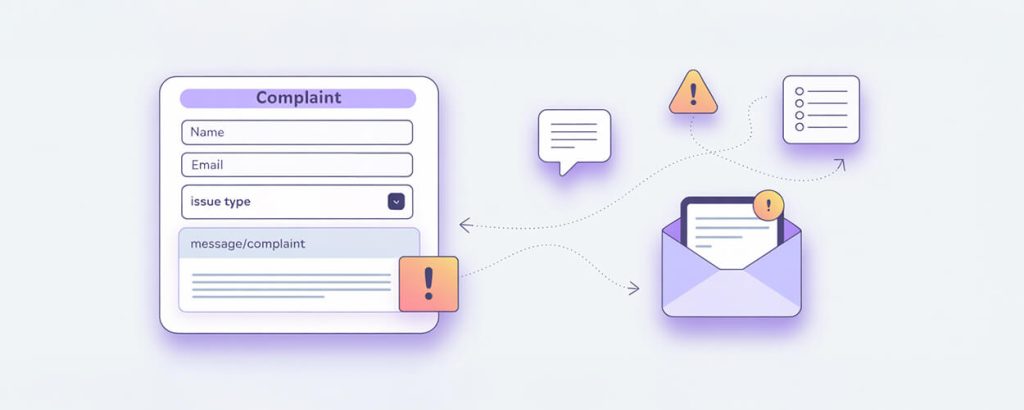
A customer complaint form is a formal manner in which the customer raises an issue of problem or concern or disaffection over a product, service or experience. It enables companies to store the information about the complaints in a clear and systematic manner so that they can review the problems, investigate and solve them effectively.
By its very definition, a customer complaint form is going to fulfill two functions:
- It provides the customers with an exclusive, dignified avenue to vent anger.
- It assists companies to convert unorganized feedback into data which can be put into action.
Feedback Forms vs Customer Satisfaction Surveys vs Complaint Forms
These tools are confusing although they have a very different purpose. Before getting into the details, let’s clear out these confusions so that you don’t get puzzled.
?Problem reporting is a design of complaint forms. They pay attention to particular cases that need to be investigated or followed up. Complaint is normally an indicator of something wrong just requiring attention.
?Feedback forms are broader. Even in the absence of any broken things, they gather views, ideas, or overall perceptions. Feedback forms are effective in the collection of ideas although not all the time they need action.
?Customer satisfaction surveys are an overall measurement of how the customers perceive the overall feeling. They usually make use of rating scales (e.g. CSAT, NPS) to get the trends in sentiment instead of issues.
In short:
- Process of fixing something requires the use of a complaint form.
- When you need ideas or opinions then use a feedback form.
- A satisfaction survey is used where you desire to measure experience on a large scale.
When Customer Complaint Form Is the Correct Tool?
The correct appropriate action to take when an issue is:
- Needs documentation
- Needs research or intensification.
- Involves multiple teams
- Possible recurrence in case it is not addressed.
When a problem with trust, service quality or compliance is encountered, customer complaint form will offer the framework to follow and manage the matter well.
As the customers navigate their way with the help of clear questions, complaint forms can decrease emotional friction and a clear and consistent response in a business, which may end up responding with clarity and consistency, before dissatisfaction is given a turn into a social outcry.
Why Customer Complaint Forms Matter More Than You Think

Customer complaint forms are often seen as a defensive tool—something businesses use only when problems arise. In reality, they play a much bigger role in retention, trust, and long-term growth.
When complaints are ignored or handled poorly, the damage goes far beyond one unhappy customer.
The Business Impact of Unresolved Complaints
Unresolved complaints rarely disappear. They surface elsewhere.
Customers who feel unheard are far more likely to:
- Stop using a product or service without warning
- Leave negative reviews on public platforms
- Share their experience with others
Industry studies consistently show that customers are willing to give a business another chance if their complaint is handled quickly and fairly. When it isn’t, churn increases—and reacquiring those customers costs significantly more than retaining them.
A structured customer complaint form helps prevent this silent loss by capturing issues early and routing them to the right people.
How Customer Complaint Forms Reduce Churn
Churn doesn’t usually happen because of one mistake—it happens because customers feel ignored.
Complaint forms reduce churn by:
- Giving customers a clear way to report problems
- Acknowledging issues before frustration escalates
- Creating accountability inside the organization
When customers see that their complaint is taken seriously, they’re more likely to stay—even if the issue itself was serious.
How Complaint Forms Prevent Negative Reviews
Most negative reviews are not written impulsively. They’re written after a customer feels there’s no other way to be heard.
Complaint forms provide a private outlet before frustration goes public. When customers have an easy way to submit a complaint:
- They’re less likely to post immediately on review sites
- They give the business a chance to respond directly
- Issues can be resolved quietly and professionally
This alone makes complaint forms a powerful reputation-management tool.
How Complaint Forms Improve Retention
Retention is built on trust.
Complaint forms help improve retention by:
- Showing customers their feedback matters
- Creating consistent response workflows
- Turning one-time complaints into long-term improvements
Businesses that track complaint patterns often uncover recurring issues that, once fixed, improve the experience for all customers—not just the ones who complained.
Why Customers Prefer Forms Over Phone or Email
Many customers avoid phone calls altogether. Others don’t want the uncertainty of sending an email and wondering if it was received.
Complaint forms offer:
- A clear structure
- Time to explain the issue calmly
- Written confirmation that the complaint was submitted
Forms remove pressure from the moment and give customers confidence that their issue won’t be lost.
Private Complaints vs Public Complaints
There’s a critical difference between private and public complaints.
Private complaints (submitted through a form):
- Are easier to resolve
- Preserve customer dignity
- Protect brand reputation
Public complaints (posted on social media or review platforms):
- Escalate quickly
- Influence other customers
- Are harder to control or resolve
A visible, well-designed customer complaint form encourages customers to complain privately first, which benefits both sides.
Trust Is Built in the Handling, Not the Form
The form itself is only the entry point. Trust is built when:
- Complaints are acknowledged promptly
- Responses are clear and respectful
- Customers see real outcomes
Businesses that treat complaint forms as part of a larger listening system consistently outperform those that rely on ad-hoc emails or reactive support.
Handled correctly, complaints become one of the most reliable signals for improving products, services, and customer relationships.
When Should You Use a Customer Complaint Form?
A customer complaint form is not something you use for every piece of feedback. It’s most effective when an issue needs structure, documentation, and follow-up.
If a situation requires more than a quick reply—or could repeat if left unresolved—a complaint form is usually the right tool.
Common Use Cases for Customer Complaint Forms
Certain situations consistently benefit from a structured complaint process.
1. Customer service issues
When customers experience slow responses, unresolved tickets, or poor communication, a complaint form helps capture what went wrong and where the breakdown occurred.
2. Product defects
Faulty products, missing items, or quality issues require clear documentation. Complaint forms allow customers to describe the issue, upload evidence, and reference orders without back-and-forth emails.
3. Billing disputes
Incorrect charges, unexpected fees, or payment errors are sensitive matters. A complaint form provides a neutral, organized way to collect transaction details and resolve disputes efficiently.
4. Delivery delays
Late or damaged deliveries often involve logistics teams, carriers, or third parties. Complaint forms help track patterns and identify recurring fulfillment issues.
5. Policy or staff complaints
Complaints involving company policies or staff behavior need careful handling. Structured forms ensure these issues are documented, reviewed consistently, and addressed fairly.
Industries Where Complaint Forms Are Essential
While any business can benefit from complaint forms, some industries rely on them more heavily due to volume, compliance, or customer expectations.
SaaS
Subscription-based businesses need clear complaint tracking to reduce churn, especially around billing, outages, or feature limitations.
eCommerce
Order issues, returns, and product quality complaints are common. Complaint forms help manage volume while maintaining customer trust.
Healthcare
Privacy, accuracy, and accountability are critical. Complaint forms provide a controlled way to report concerns without escalating them publicly.
Education
Institutions use complaint forms to handle issues related to administration, teaching quality, or facilities while maintaining proper records.
Government and public services
Transparency and documentation are mandatory. Complaint forms ensure concerns are logged, reviewed, and resolved according to formal processes.
In short, use a customer complaint form whenever an issue:
- Needs tracking
- Requires accountability
- Involves more than one team
- Could impact trust or compliance
If the problem matters enough to fix, it matters enough to document.
What Makes a Good Customer Complaint Form?

A customer complaint form is not just a data collection tool—it’s a communication tool. Most complaint forms fail because they focus on what the business wants to know, not how the customer feels when filling it out.
To design an effective complaint form, you need to consider both user experience (UX) and psychology.
The Emotional State of the Complainant
Customers don’t submit complaint forms in a neutral state. They are often:
- Frustrated
- Disappointed
- Confused
- Feeling ignored
A good complaint form acknowledges this emotional context without saying it explicitly. The goal is to help customers feel heard, not interrogated.
Simple cues—such as a calm introduction, respectful wording, and a clear next step—can immediately reduce tension.
Friction vs Clarity: Finding the Right Balance
Friction isn’t always bad. Some structure is necessary to understand what went wrong. The problem starts when forms introduce unnecessary friction.
Too much friction:
- Long forms
- Redundant questions
- Mandatory fields with no clear purpose
Too little friction:
- Vague questions
- Missing context
- Incomplete complaints that require follow-up
A good complaint form strikes a balance—asking only what’s needed, in the clearest way possible.
Why Shorter Forms Lead to Better Resolution Outcomes
Shorter complaint forms don’t just improve completion rates—they improve resolution quality.
When forms are concise:
- Customers explain issues more clearly
- Support teams receive focused information
- Complaints are processed faster
Long, exhausting forms often lead to rushed or emotional answers, which slows down investigation and resolution.
The goal isn’t to collect everything—it’s to collect the right things.
Key UX Rules for Customer Complaint Forms
One question per screen (optional)
Breaking questions into steps can make forms feel less overwhelming, especially on mobile devices. This approach works particularly well for detailed complaints.
? You can check out our blog about – How To Create Conversational Forms
Set clear expectations
Let users know what will happen next. A simple message like “We’ll review your complaint and respond within 48 hours” builds trust and reduces anxiety.
Use neutral, non-defensive language
Avoid wording that implies blame or skepticism. Replace phrases like “Why did this happen?” with “What happened?” Small changes in tone make a big difference.
A good customer complaint form does more than collect information—it de-escalates frustration, guides customers calmly, and sets the stage for resolution. When UX and psychology are handled correctly, the form itself becomes the first step toward rebuilding trust.
5+ Essential Fields Every Customer Complaint Form Must Have

A customer complaint form is only as effective as the information it collects. Missing key details leads to delays, confusion, and unnecessary follow-ups. On the other hand, collecting too much information creates friction and discourages completion.
The goal is to include only the fields that help resolve the issue, with optional fields that add clarity when needed. These fields form the foundation of any effective customer complaint form.
1. Customer name and contact details
You need a way to follow up. At minimum, collect a name and one reliable contact method, such as an email address or phone number. Without this, resolution becomes difficult or impossible (except in anonymous complaints).
2. Complaint category
A category field helps route complaints to the right team. Examples include billing, product quality, customer service, or delivery issues. Categorization speeds up internal handling and analysis.
3. Description of the issue
This is the most important field. Use an open-text area that encourages clear explanation without forcing long responses. Prompting with a short hint (for example, “Please describe what happened”) improves clarity.
4. Date and time of the incident
Knowing when the issue occurred helps teams investigate logs, transactions, or support records. It also helps identify patterns when similar complaints appear.
5. Desired resolution
Asking what the customer expects—refund, replacement, explanation, or follow-up—prevents assumptions and aligns responses with customer expectations.
Optional (But Powerful) Fields
These fields are not always required, but they significantly improve resolution quality when used correctly.
6. File upload (screenshots, invoices, photos)
Attachments reduce back-and-forth. Screenshots, receipts, or photos often explain more than text alone, especially for product or billing complaints.
7. Priority or urgency selector
Letting customers indicate urgency helps teams triage complaints. Use clear options such as low, medium, or high to avoid confusion.
8. Consent and data usage checkbox
A consent checkbox builds trust and supports compliance. It reassures customers that their data will be handled responsibly and used only to resolve the complaint.
Required vs Optional Fields: Quick Comparison
| Field Type | Purpose | When to Use |
| Name & contact details | Enables follow-up and resolution | Always (except anonymous forms) |
| Complaint category | Routes issues efficiently | Always |
| Issue description | Explains what went wrong | Always |
| Date/time of incident | Supports investigation | Always |
| Desired resolution | Aligns expectations | Always |
| File upload | Adds clarity and evidence | When relevant |
| Urgency selector | Helps prioritize responses | High-volume environments |
| Consent checkbox | Builds trust and compliance | Recommended |
A strong customer complaint form includes the essentials by default and uses optional fields thoughtfully. The right balance ensures customers can explain their issue clearly—without feeling overwhelmed—while giving your team everything needed to respond effectively.
Customer Complaint Form Question Examples

One reason many customer complaint forms underperform is that they rely on vague or poorly worded questions. Clear, neutral wording helps customers explain issues calmly and gives your team usable information from the start.
Below are stealable question examples, grouped by purpose. You don’t need to use all of them—choose what fits your use case.
A. Complaint Identification Questions
These questions help you understand what the complaint is about and where it should be routed.
Example questions
- What best describes your complaint?
(Billing issue, product quality, delivery delay, customer service, other) - Which product or service does this complaint relate to?
- Do you have an order number, ticket ID, or reference number?
(Optional but helpful)
These questions allow teams to categorize and triage complaints quickly without reading the full description first.
B. Incident Detail Questions
This section captures what actually happened. Keep the wording neutral and open.
Example questions
- Please describe the issue you experienced.
- When did this issue occur?
- Where did the issue take place? (Online, in-store, during delivery, etc.)
Avoid language that sounds accusatory. Your goal is clarity, not interrogation.
C. Impact and Severity Questions
These questions help you understand how serious the issue is and how urgently it needs attention.
Example questions
- How did this issue affect you?
(Unable to complete a purchase, financial impact, inconvenience, service disruption) - How urgent is this matter?
(Low, medium, high) - Is this issue still ongoing?
(Yes / No)
Impact questions help teams prioritize complaints that require immediate action.
D. Resolution Expectation Questions
Resolution questions clarify what the customer wants to happen next.
Example questions
- What outcome would you consider a satisfactory resolution?
(Refund, replacement, explanation, follow-up call) - Would you like us to contact you about this complaint?
(Yes / No) - What is the best way to reach you if we need more information?
Understanding expectations early reduces frustration and speeds up resolution.
Well-structured complaint questions turn emotional feedback into clear, actionable input. By organizing questions into logical sections, your customer complaint form becomes easier to complete—and far easier to resolve.
Customer Complaint Form Template
Templates are great solutions for creating a form quickly. It saves time and helps to take prompt action. Here is a Customer Complaint Form Template that you can use on the go. Also, it has customizable options so that you can add or remove options as per your requirement.
5 Common Mistakes Businesses Make With Complaint Forms

Many customer complaint forms fail not because of bad intentions, but because of poor execution. These mistakes often go unnoticed internally, yet they are immediately felt by customers.
Below are the most common—and costly—mistakes businesses make when handling complaints through forms.
1. Asking Too Many Questions
Long complaint forms increase frustration instead of reducing it.
When customers are already upset, forcing them to answer unnecessary questions leads to:
- Incomplete submissions
- Rushed or unclear answers
- Abandoned forms
Experienced support teams know that clarity beats completeness. It’s better to collect essential information first and request more details later if needed.
2. Using Defensive or Blaming Language
Subtle wording choices can completely change how a form feels.
Phrases that imply doubt or blame—such as “Why did this happen?” or “Explain your issue clearly”—can escalate emotions and reduce trust.
Neutral language like “What happened?” or “Please describe the issue” keeps the tone respectful and calm.
This isn’t theory. Teams consistently see better outcomes when complaint forms avoid defensive phrasing.
3. No Confirmation After Submission
Few things frustrate customers more than submitting a complaint and hearing nothing back.
Without a confirmation message:
- Customers aren’t sure their complaint was received
- Anxiety increases
- Duplicate complaints are submitted
An immediate acknowledgement reassures customers and sets expectations from the start.
4. No Follow-Up After Resolution
Resolving a complaint without follow-up misses a critical opportunity.
A short follow-up:
- Confirms the issue was handled properly
- Shows respect for the customer’s time
- Provides insight into process gaps
Businesses that skip this step lose valuable feedback and weaken trust.
5. No Ownership or Accountability
When complaints aren’t assigned to a specific person or team, they stall.
Lack of ownership leads to:
- Delayed responses
- Inconsistent resolutions
- Repeated customer frustration
High-performing organizations assign clear responsibility for every complaint and track progress until closure.
These mistakes are rarely intentional—but they are avoidable. Businesses that treat complaint forms as part of a broader accountability system consistently resolve issues faster, retain more customers, and build stronger trust over time.
5 Best Practices Of Customer Complaint Form That Works Great
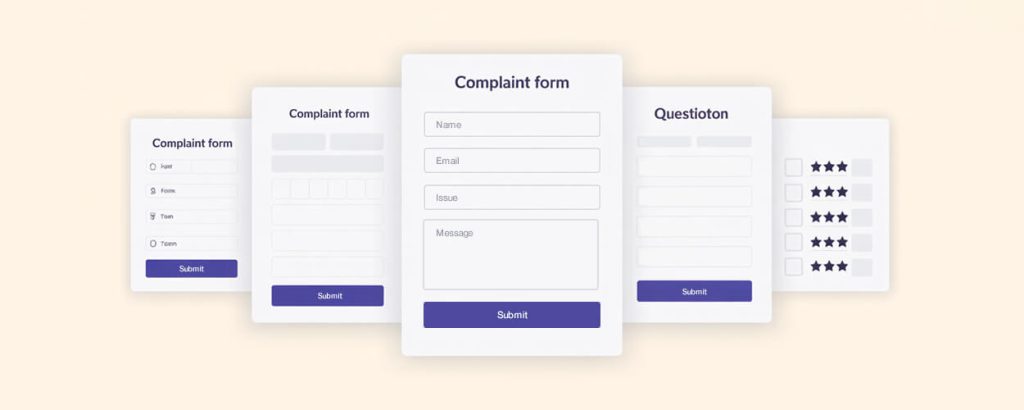
A customer complaint form works best when it’s treated as part of your customer experience—not as a last resort. The following best practices come from real-world usage across support, operations, and compliance-driven teams.
Use this checklist to make sure your complaint form actually helps both customers and your business.
1. Keep Complaint Forms Accessible
If customers have to search for a complaint form, they’re already frustrated.
Best practices include:
- Mobile-friendly design
- Clear, readable layout
- No login required unless absolutely necessary
Accessibility isn’t just about usability—it signals that you’re open to listening.
2. Make Complaint Forms Easy to Find
Complaint forms shouldn’t be hidden.
Place them where customers expect to find help:
- Support or help center pages
- Footer links
- Account dashboards
- Order or invoice pages
When forms are easy to find, customers are more likely to complain privately instead of publicly.
3. Allow Anonymity When Appropriate
Not all complaints are comfortable to submit with a name attached.
Anonymous complaint forms are especially important for:
- Staff or conduct-related issues
- Sensitive environments
- Compliance or whistleblowing scenarios
When anonymity is offered, clearly explain what it means and any limitations on follow-up.
4. Close the Feedback Loop
Submitting a complaint should never feel like shouting into the void.
Closing the loop means:
- Acknowledging the complaint
- Providing updates when possible
- Confirming resolution
Even a short message saying “We’ve reviewed your complaint” makes a meaningful difference.
5. Track Complaint Patterns Over Time
Individual complaints matter—but patterns matter more.
Tracking complaint data helps you:
- Identify recurring issues
- Improve processes and products
- Prevent future complaints
Complaint forms are one of the most reliable sources of operational insight when reviewed consistently.
When these best practices are followed, customer complaint forms stop being reactive tools and become proactive systems for improving trust, service quality, and long-term customer relationships.
How to Create a Customer Complaint Form (Step-by-Step)
Creating an effective customer complaint form requires more than just adding a few fields. The goal is to collect clear information, reduce frustration, and guide complaints toward resolution—not escalation.
Below is a practical, step-by-step approach to creating a customer complaint form that works across industries and complaint types.
1. Start With the Right Structure
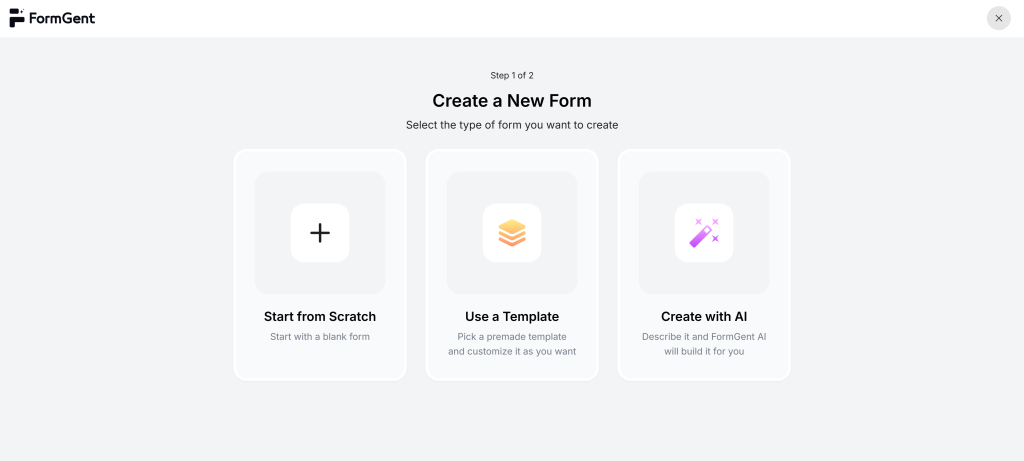
Begin by deciding whether your complaint form should be:
- A general complaint form for all issues, or
- A use-case based form (billing, product, service, conduct)
If you’re just starting, a general complaint form with conditional logic is usually the most flexible option. It allows one form to handle multiple complaint scenarios without overwhelming users.
2. Choose the Appropriate Layout
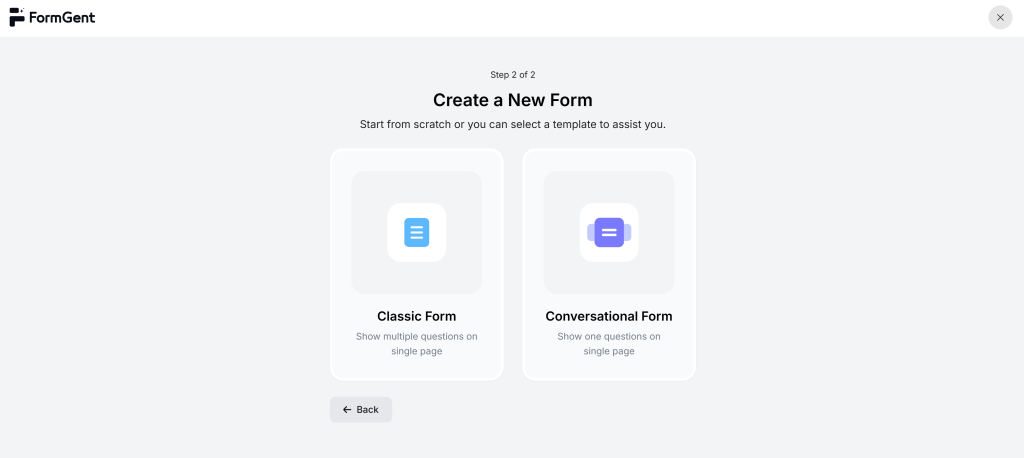
Layout affects how comfortable customers feel while submitting complaints.
- Single-page forms work well for simple complaints
- Step-by-step (one question at a time) layouts are better for detailed or emotional complaints
Guided layouts reduce cognitive load and help customers explain issues more clearly.
? You can check out our blog about – How To Create Conversational Forms
3. Add and Customize Essential Complaint Fields
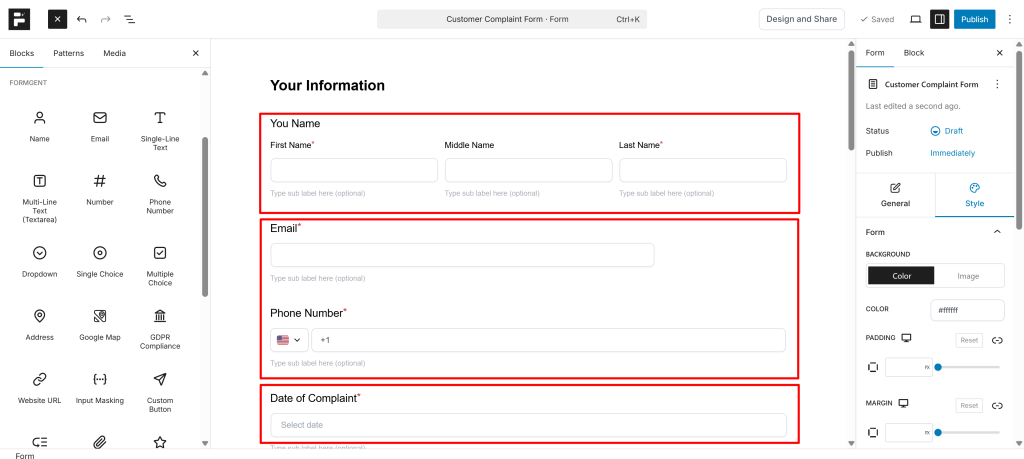
Include only the fields that help resolve the issue.
Core fields typically include:
- Customer name and contact details (optional for anonymous complaints)
- Complaint category
- Description of the issue
- Date or timeframe of the incident
- Desired resolution
Depending on the complaint type, you may also add:
- File uploads for screenshots, invoices, or photos
- Rating or severity indicators
- Reference numbers (order ID, ticket number)
Avoid unnecessary questions. If a field doesn’t help resolution, it doesn’t belong in the form.
4. Use Conditional Logic to Keep Forms Short
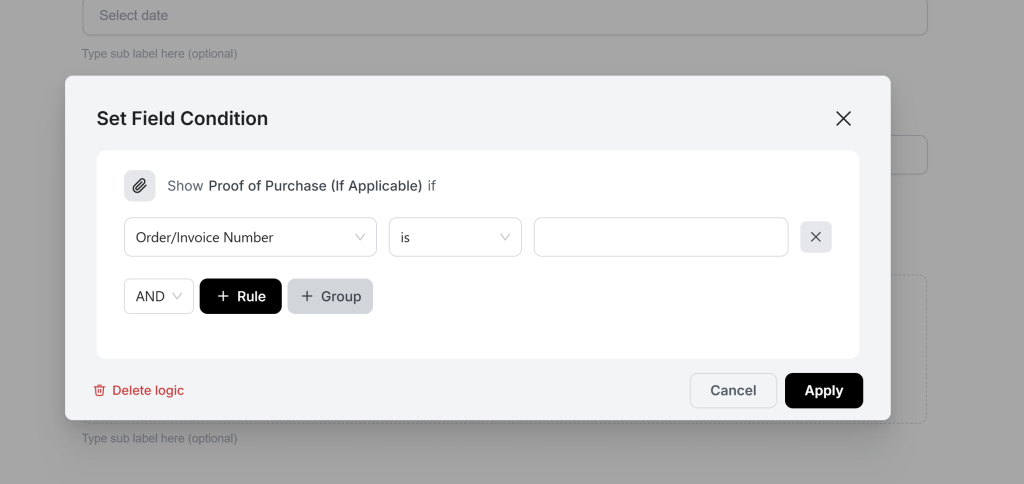
Conditional logic allows your complaint form to adapt based on customer input.
For example:
- Billing-related selections can reveal payment details
- Product complaints can display file upload fields
- Staff conduct complaints can trigger anonymity options
This keeps forms concise while still collecting detailed, relevant information.
5. Design for Calm and Clarity
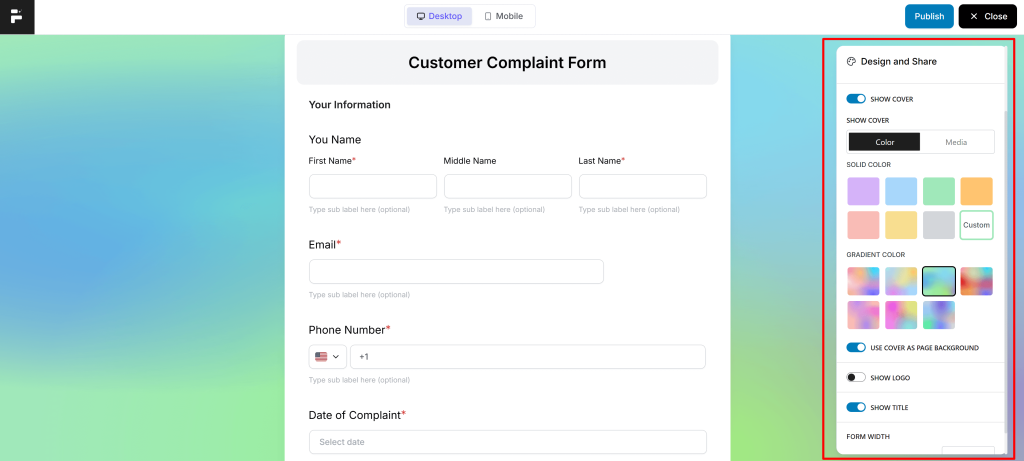
The visual design of a complaint form matters more than most businesses realize.
Best practices include:
- Neutral colors and readable fonts
- Clear spacing between questions
- Simple, reassuring language
- A short introduction explaining what will happen next
Design should reduce tension—not amplify it.
6. Set Up Notifications and Acknowledgements
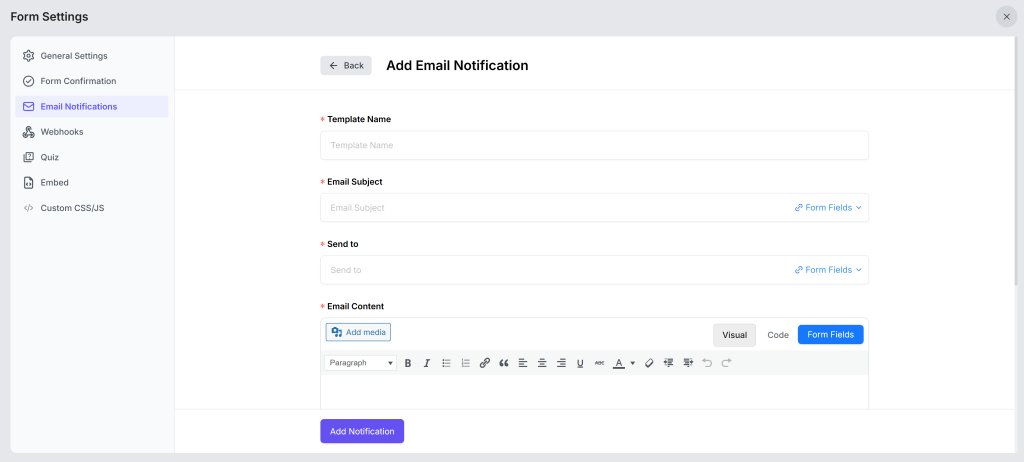
Every complaint should receive immediate confirmation.
Key automations to include:
- A confirmation message or email for the customer
- Internal notifications routed to the correct team
- Priority-based alerts for urgent complaints
Acknowledgement builds trust and prevents duplicate submissions.
7. Publish and Make the Form Easy to Find
A complaint form should never be hidden.
Common placement options:
- Support or help center pages
- Account dashboards
- Footer links
- Order confirmation or billing emails
Visibility encourages private resolution over public complaints.
8. Test the Form Before Going Live
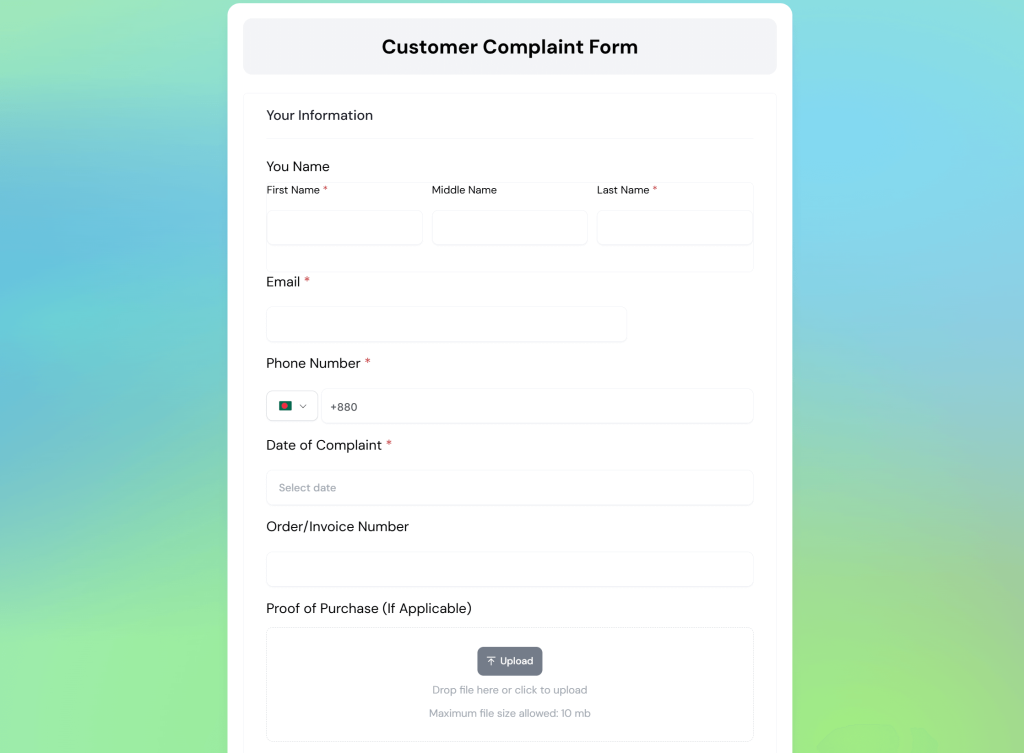
Before publishing:
- Test all conditional logic
- Submit test complaints
- Confirm notifications and confirmations
- Review the form on mobile devices
A broken complaint form damages trust instantly.
9. Monitor, Review, and Act on Complaints
Creating the form is only the beginning.
Use complaint submissions to:
- Identify recurring issues
- Improve internal processes
- Reduce future complaints
- Measure resolution effectiveness
A complaint form without follow-through is worse than no form at all.
Want To Easily Create Customer Complaint Form?
For WordPress users, FormGent simplifies this entire process by allowing you to:
- Generate complaint forms using AI
- Apply conditional logic effortlessly
- Automate complaint routing and notifications
- Securely manage complaint data
FormGent doesn’t replace your complaint process—it helps you implement it faster and more consistently.
A well-built customer complaint form doesn’t just collect issues.
It signals accountability, builds trust, and turns dissatisfaction into meaningful improvement.
How to Handle Complaints After Submission
Creating a customer complaint form is only the first step. What truly determines customer trust is what happens after the form is submitted. Without a clear handling process, even the best form fails.
A structured workflow ensures complaints are acknowledged, addressed, and resolved consistently.
Step-by-Step Complaint Handling Workflow
1. Acknowledgement email
As soon as a complaint is submitted, send an automatic confirmation. This reassures the customer that their complaint was received and is being reviewed. The message should be calm, neutral, and clear about next steps.
2. Internal routing
Route the complaint to the appropriate team based on category, urgency, or department. Clear ownership prevents complaints from being overlooked or passed around without accountability.
3. Investigation
Review the details, attachments, and any related records. This step may involve checking transaction logs, support tickets, or speaking with internal teams to understand what went wrong.
4. Resolution
Respond with a clear explanation and proposed solution. Even when the outcome isn’t what the customer hoped for, transparency and respectful communication make a significant difference.
5. Follow-up feedback
After resolution, ask whether the issue was handled satisfactorily. This closes the loop and helps identify areas where your process can improve.
Response Time Expectations
Clear response timelines build trust and reduce frustration.
Same day acknowledgement
Customers should receive confirmation immediately or within a few hours. Silence at this stage increases anxiety and dissatisfaction.
24–48 hour initial response
Most complaints should receive a meaningful response within one to two business days. This doesn’t always mean full resolution—but it should show progress.
Escalation thresholds
Define when complaints need escalation, such as:
- No resolution after a set time
- High-severity issues
- Repeated complaints on the same topic
Escalation ensures serious issues receive appropriate attention without delay.
A clear post-submission process turns customer complaint forms into a trust-building system. When customers know what to expect—and see follow-through—complaints stop feeling like conflicts and start becoming conversations.
Metrics to Track From Customer Complaint Forms
Customer complaint forms don’t just help you resolve individual issues—they generate data that can improve your entire operation. Without tracking the right metrics, complaints remain isolated events instead of signals for improvement.
Below are the most important metrics to track and why they matter.
Complaint Volume Trends
Tracking how many complaints you receive over time helps you spot patterns early.
Rising complaint volume may indicate:
- Product quality issues
- Service delays
- Process breakdowns
A sudden drop can be positive—or it may mean customers have stopped reporting issues altogether. Context matters.
Resolution Time
Resolution time measures how long it takes to close a complaint from submission to final response.
Why it matters:
- Faster resolution builds trust
- Long delays increase frustration
- It reveals internal bottlenecks
Monitoring average and maximum resolution times helps teams stay accountable.
Repeat Complaint Rate
Repeat complaints signal unresolved root problems.
If customers complain about the same issue multiple times:
- The original resolution may be incomplete
- The problem may be systemic
- Expectations may not be aligned
A low repeat complaint rate usually indicates effective handling.
Complaint Category Frequency
Tracking complaint categories shows where problems occur most often.
For example:
- Billing complaints may highlight pricing confusion
- Delivery complaints may point to logistics issues
- Service complaints may indicate staffing gaps
Category frequency helps prioritize improvements that impact the most customers.
Post-Resolution Satisfaction
Resolution isn’t complete until the customer confirms it.
Post-resolution satisfaction measures how customers feel after their complaint was handled. This can be captured with a short follow-up question or survey.
This metric closes the loop and ensures complaints actually lead to better experiences.
When tracked consistently, complaint metrics turn individual issues into strategic insights. They help businesses move from reacting to complaints to preventing them altogether.
Final Thoughts: Turning Complaints Into Trust
Customer complaints are often seen as problems to minimize. In reality, they are opportunities to improve—if you’re willing to listen.
Every complaint highlights a gap between expectation and experience. When addressed properly, that gap becomes a chance to strengthen relationships rather than damage them.
Complaints Are an Opportunity, Not a Threat
Customers who complain are still engaged. They care enough to explain what went wrong instead of walking away silently.
Handled well, complaints can:
- Reveal hidden issues before they escalate
- Improve products, services, and processes
- Restore confidence after a negative experience
Ignoring complaints doesn’t make problems disappear—it just pushes them elsewhere.
Why Private Listening Builds Loyalty
When customers are given a private, respectful channel to share concerns, they’re far less likely to voice frustration publicly.
Private complaint handling:
- Preserves customer dignity
- Protects brand reputation
- Creates space for honest resolution
Many long-term customers stay loyal not because mistakes never happen—but because those mistakes are handled with care.
The Long-Term Value of Structured Complaint Handling
A structured complaint system does more than resolve individual issues.
Over time, it helps businesses:
- Identify recurring problems
- Improve operational efficiency
- Reduce churn
- Build trust through consistency
Customer complaint forms are not just reactive tools. When designed and handled thoughtfully, they become one of the most reliable inputs for continuous improvement.
Listening, responding, and improving—consistently—is how complaints turn into trust.
Customer Complaint Form FAQs
What should a customer complaint form include?
A customer complaint form should include only the essential fields and only the information required to understand the issue and resolve it. Essential fields include Customer name and contact details, Complaint category, Description of the issue, Date or timeframe of the incident, Desired resolution. Optional fields such as file uploads or urgency levels can improve clarity but should not be mandatory.
Should complaint forms be anonymous?
Complaint forms should allow anonymous submissions when sensitivity or fear of retaliation may prevent honest reporting. Businesses should clearly explain that anonymity may limit follow-up communication.
How long should a customer complaint form be?
A customer complaint form should be short and focused. The form should take no more than 3–5 minutes to complete. Only essential fields should be required. Additional details can be collected during follow-up. Shorter forms result in higher completion rates and clearer responses.
Are customer complaint forms legally required?
Customer complaint forms are legally required in some industries and regions.
Sectors such as healthcare, education, financial services, and public institutions often have formal complaint-handling obligations. Legal requirements vary by location, so businesses should verify applicable regulations.
What is the difference between a complaint form and a feedback form?
A complaint form is used to report a specific problem that requires investigation or resolution.
A feedback form is used to collect general opinions, suggestions, or impressions and does not always require follow-up.
Using the correct form ensures customer input is handled appropriately.
What is a customer complaint form?
A customer complaint form is a organized process to collect detailed negative feedback from the customers by online or offline. This process allows customers to give negative experience related with product, services or staff. Customer complaint form helps to figure out customer’s specific problems and take quick actions for solving problem and further improvements.
Why are Customer Complaint Forms important?
They help businesses or services to find out customer complain about the product, service or any related issue.
What information is normally collected in a Customer Complaint Form?
There are some common fields in a Customer Complaint Form like contact details, complain proof, specific feedback or some open ended fields for comments.
Who should use Customer Complaint Form?
Almost all product or service based organization like businesses, healthcare providers, educational institutions, and non-profits can use Customer Complaint Form to collect complaint from the customers.
Is there any option to create an anonymous Customer Complaint Form?
Yes. With FormGent, you can create anonymous Customer Complaint Form. But in this case, it’ll be difficult to make further communication with the customer.
Can Customer Complaint Form be integrated with other tools?
There are lots of integrations available in Customer Complaint Form with FormGent. You can integrate your Customer Complaint Form with Payment gateways, Zapier, Google Sheet, MailChimp, Zoho CRM and automates your workflow.

Rezaul Karim
Rezaul Karim is a passionate Digital Marketer driven by curiosity and creativity in the ever-evolving world of online marketing. With over 6 years of hands-on experience in Content Writing, Copywriting, SEO, and Social Media Marketing, he brings a strategic edge to crafting content that engages and converts. Always eager to explore new trends and tools, Rezaul thrives on finding smarter ways to connect brands with their audiences. Outside of work, he enjoys diving into books or recharging in nature.


Leave a Reply